What I built
I built a cross-market factor transfer and post-publication audit pipeline across 105 crypto spot and USDT-margined perpetual pairs on Binance (730-day development panel plus 92-day frozen post-publication tracking) and OKX.
Research question and cross-market transfer
Question: Do the factors of a 32-report sell-side market-microstructure series written for China A-shares carry over to crypto, where minute bars, taker-side order flow, and perpetual-futures data are freely available?
Short 120-day crypto windows easily manufacture apparent Sharpe > 3.0 factors that turn negative over a full 730-day cycle. Extending the panel to 105 coins × 730 days (2024-06 to 2026-05) shows that most equity order-flow and momentum factors fail or prove parameter-fragile; the signals that survive are perpetual-futures funding rates, retail long/short positioning, and low-price range amplitude.
Capabilities demonstrated
- Reconstruct 32 equity microstructure and derivatives factors from 1-minute spot/perpetual klines, funding rates, open interest, and long/short ratios.
- Enforce split-sample sign consistency, parameter-grid stability, rolling-window positivity, universe-breadth checks, and cross-exchange replication on OKX.
- Decompose funding-rate factor returns into price reversal (83%) versus direct funding carry accrual (17%).
- Freeze the deliverable market-neutral composite at publication (2026-05-31 data cutoff) and report unmodified out-of-sample monthly updates for June, July, August, and September 2026 without re-fitting.
Pre-publication transfer vs post-publication tracking
| Factor / Composite | Window | Metric | Outcome |
|---|---|---|---|
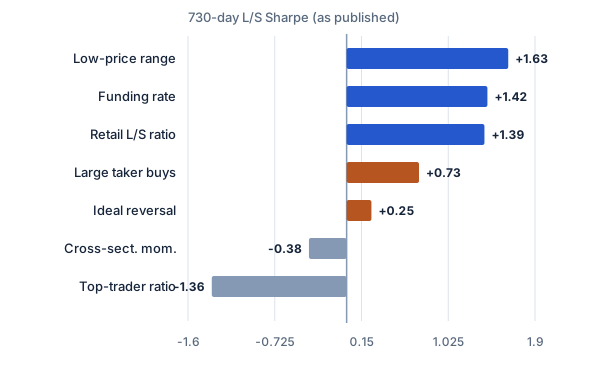
| Perpetual funding rate | 730d pre-pub (2024-06–2026-05) | Sharpe +1.42 | Positive in both halves and 91% of rolling windows; confirmed on OKX; 83% price reversal + 17% carry. |
| Retail long/short ratio | 730d pre-pub (2024-06–2026-05) | Sharpe +1.39 | Robust contrarian positioning signal; remained positive post-publication (+11.8% L/S through Sep 2026). |
| Low-price range | 730d pre-pub (2024-06–2026-05) | Sharpe +1.63 | Most parameter-stable factor in the 2024–2026 altcoin bear market; confirmed on OKX. |
| Market-neutral composite (pre-pub) | 515-day backtest panel (2025-01-01 to 2026-05-31) | NAV 1.35 (Sharpe +1.18) | Top-8 large-cap spot long + ideal equal-weight perpetual index short, weekly rebalance, max drawdown −11.5%. With tradable hedges, the 2026-10 audit finds Sharpe 0.81 (24-perpetual short with funding and fees) and −0.03 (BTC/ETH 50/50) over 537 days. |
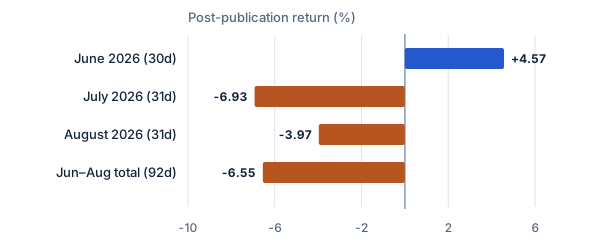
| Market-neutral composite (post-pub OOS) | 92d (June–August 2026) | −6.5% cumulative | +4.6% in June, −6.9% in July, −4.0% in August (max drawdown −11.9%) as altcoin rallies squeezed the funding and range short legs. |
v2.0 785-day composite overlays (published record, superseded)
These rows combine the three surviving factors over 2024-06-03 to 2026-07-27 and overstate performance. The factor NAVs carry the long–short cost formula that charged about 2.5 bp per side instead of the stated 5 bp; the published overlay rows charged nothing for re-weighting; and the factors and gate were chosen in sample (728 of the 785 days precede publication, and the funding-squeeze gate was added after the June–August 2026 squeeze). The BH-FDR step ran only on a 10-date sample fixture.
| Composite Variant (as published) | 785d Cum Return (%) | 785d Sharpe | 785d Max DD (%) | Calmar | NW t-stat | Pre-Pub 728d Sharpe |
|---|---|---|---|---|---|---|
| Static Equal-Weight Core-3 | +150.75 | 1.87 | -16.26 | 3.28 | 2.95 | 1.89 |
| 15% Volatility-Targeted Core-3 | +91.00 | 1.85 | -12.54 | 2.80 | 2.79 | 1.91 |
| 20d Inverse-Vol + 5d Funding Squeeze Gate | +163.88 | 2.19 | -14.88 | 3.83 | 3.23 | 2.23 |
| 20d Inverse-Vol + Squeeze Gate + 15% VolTarget | +96.95 | 2.12 | -8.55 | 4.33 | 3.13 | 2.18 |
Charging the overlays 5 bp per side on the notional they trade when re-weighting (the pipeline default since 2026-10-26), on the same published factor NAVs; still upper bounds:
| Composite Variant (overlay cost charged) | 785d Cum Return (%) | 785d Sharpe | 785d Max DD (%) | Calmar | Overlay cost (%/yr) |
|---|---|---|---|---|---|
| Static Equal-Weight Core-3 | +150.75 | 1.87 | -16.26 | 3.28 | 0.00 |
| 15% Volatility-Targeted Core-3 | +86.41 | 1.79 | -12.83 | 2.62 | 1.13 |
| 20d Inverse-Vol + 5d Funding Squeeze Gate | +147.52 | 2.05 | -14.93 | 3.51 | 2.98 |
| 20d Inverse-Vol + Squeeze Gate + 15% VolTarget | +86.57 | 1.96 | -9.25 | 3.64 | 2.52 |
The project’s own 2026-10 stress test of the vol-targeted composite (835 days through 2026-10-20) gives Sharpe 1.48 at 5 bp when filled at the signal-day close, 1.18 at 15 bp and 0.72 at 30 bp with a 1-minute delay. Its generator is not committed. A rerun of all of these with the corrected cost formula is pending access to the raw Binance panels.
Reproduce and inspect
Run make setup, make test, and make reproduce-sample to verify the published factor transfer and post-publication summary tables.
Evidence boundary
- Backtest and post-publication out-of-sample backtest association, not live trading.
- Fills at the close that completes the signal (no execution lag) and omit market impact; the large-coin pool holds roughly five names per leg.
- Published long–short tables charged about 2.5 bp per side instead of the stated 5 bp. The code was corrected on 2026-10-26; the tables await a rerun on the raw panels.
- The 2024–2026 development sample is predominantly an altcoin bear market, and OKX funding history via public API is roughly three months.